Alberta’s Volunteer of the year, known as Granny, ‘is love’
Whitecourt Star
Story and photos by Ann Harvey
Editor
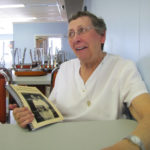
Irma Gray keeps watch on Tennille’s Hope Kommunity Kitchen activities as she talks to the interviewer, once stopping the interview while she helps a woman who comes to her for advice.
She’s polite and friendly, but the 73-year-old who has been chosen as the 2011 Alberta Volunteer Citizen of the Year – an award presented by the Alberta Weekly Newspapers Association with a $5,000 prize sponsored by Direct Energy – has clear priorities. Taking care of others outweighs any praise for her.
Watching the guests, she takes care of their needs. That includes getting them to help so that through contributing they become part of the community that is Tennille’s Hope.
That’s so important for her that she’s donating the prize to the soup kitchen.
Bob Walker, a former Whitecourt fire chief and town councillor, wrote to Direct Energy nominating her for the award. He said he’s known her for 45 years since she first worked at the Whitecourt Hotel and he’s seen what she does to help others.
“In my books she’s number one.”
Gray’s role at the soup kitchen begins with cooking, her lifelong career but, although food may be love to her, she embraces the people it serves in every way as she has embraced her community all her life.
Born at Greencourt, a small community near Barrhead, she is the daughter of immigrants from the U.S. “My Dad was born just out of Peoria, Illinois. I think my Mom was born in Minnesota.
“My Mom came with her parents and my Dad just came up here, I guess, looking for a different life.
“I was born in a little house. I’m from a family of seven. I’m the youngest girl and I’ve got one brother who’s five years younger than me.”
All of the children but her youngest brother were born at home without any medical help. “He had a kind of midwife or nurse.”
“I went to Grade 1 in Greencourt. Then we moved to our farm that’s 12 miles north of Mayerthorpe.
“My oldest brother still lives there.”
After she grew up, the then-Irma Collins didn’t travel far.
“When I was 17, I came to Whitecourt and I worked what is the Howard Johnson now. It was called the Whitecourt Hotel then and was the only hotel in Whitecourt.
“My sister and brother-in-law managed the restaurant. Oil was just starting then in Whitecourt.
“The Greyhound bus stopped at the hill and we were very, very busy.
“She (her sister) was a tough boss, but she instilled habits and work ethics in my life that I still carry on. You never left your shift unless the kitchen floor was washed.”
It set her on a career path. “I was 17 and I’m 73 now so that tells you how many years I’ve been messing with food.”
She wasn’t straying from her upbringing. Her mother was a stay-at-home farm wife – typical of those times – who stayed at home with the children and made good meals, but it was her father who excelled.
“My Dad was a very, very good cook. My Dad would go out cooking in lumber camps and nobody went in his dining room to eat if they had their hats on, there feet were dirty or they used bad language.”
She has no regrets. “I love it. I think one of my biggest most rewarding things I did in my life is I wrote a cookbook.
“Over the years I learned so many shortcuts and little kind of tricks that I had to learn by trial and error and I love to pass it on.”
At the same time she began the public service that continued through her life. “When I first came to Whitecourt I lived in a little house where it’s (a) suntanning (business) now beside the old United Church. I lived with this old Mrs. Brown her name was.”
She’d never gone to church before but took to it readily. “I immediately was involved in the United Church and I taught midweek groups like Explorers, Brownies and Guides.”
Then she married, Allan Gray, and through the years when they had their first three children, they lived in the bush. “My husband had a lumber camp.
“He would come in once a week but I wouldn’t come in all winter. “I cooked when you didn’t have a kitchen full of groceries. It was a cold, hard life.
“We hauled our own water from the creek. You just had to do with what you had.”
Eventually they moved into town. “We had a house were the parking is there on the corner across from the Anglican Church and across the road from the library. We build that house.
“I worked in cafes for a long time. He had a gravel truck and he hauled gravel.”
Between September 1969 and October 1989 they owned Jackpine Motel where they brought had more children bringing their family size from five to seven — five daughters and two sons who have now had 19 grandchildren and 10 great-grandchildren.
The little ones accompanied her as she worked in the motel. “I used to take them from room to room.”
The couple also opened their hearts to other children.
“We took in a girl, a teenager who needed somewhere to be.”
Again that seemed natural to her, she said. “My Dad would help everybody he could.’
Much of the work of being a parent on her because her husband had to be away working. “It was me that took the boys to play hockey and the girls for figure skating.”
“During all that time I served on was what was called the Low Rental Housing board. We looked after the low rentals that are north of Central School.”
Through that time her children grew up and she became a widow. “I lost my husband on Jan. 10 of 2005. We had been married 49 years that Halloween.”
She has naturally continued community volunteering during what others might call their retirement years. Cooking for Tennille’s Hope is just one of the most visible thing she does.
Getting donations is another. “We know where we can go quite often and pick up the different food supplies that are donated.”
“I have never gone anyplace yet and asked for a donation that I don’t get it.”
She’s does just as well when asking for items for silent auctions. “I never get refused.”
Fundraising for Lorne’s Blanket, Whitecourt’s wintertime homeless shelter, was the same. “The first real fundraiser we had for Lorne’s Blanker, we had in the Senior’s Circle and I remembers just as distinctly was such a success.
“I went out and got donations. I had everything from car creepers to produce. You can imagine the variation of donations that I got.
“I don’t know how much money we made at that but that was the kickoff for our homeless shelter. I’ve done everything I could in the background since.”
And she’s been touched but people’s willingness to help her. Another fundraiser, a sleepover for Lorne’s Blanket in the church parking lot, was initiated by Pastor Michelle Harder at the Family Worship Centre. When she asked for sponsors for camping in the cold, she told people she didn’t know how many hours she would be doing it.
They replied saying they would contribute and it didn’t matter how many hours she spent. “We collected, I’m sure it was over $3,000 with folks driving in Tim Horton’s and stopping and giving us donations.
Serving on the committee that provides alternative justice to youth, she will offer the friendship of a “granny” to young people. “We often get young girls and they so often want somebody that they can relate to.”
Just buying them a plate of fries and listening, make a difference they appreciate, she said.
Singing at the seniors lodges is another thing she says she enjoys. “They’re sitting there so dainty.”
Then after a song or two – especially her signature tune, One Day at a Time – they change. “It’s really funny to see how they’ll come out of their shells.”
Why does she do it? Why does she give so much of her time and energy to others?
“I love people. I love working with people. If I ever won the lottery or any amount of money there wouldn’t be many poor people especially kids that I know.
“I love giving to people who don’t have as much as I do.”
And why go to the trouble of cooking when she could just give money? That’s not just because she loves cooking.
“I would rather tell the person: ‘Would you come for lunch with me” because I know sometimes it (money) doesn’t go for food.”